HOME | DD
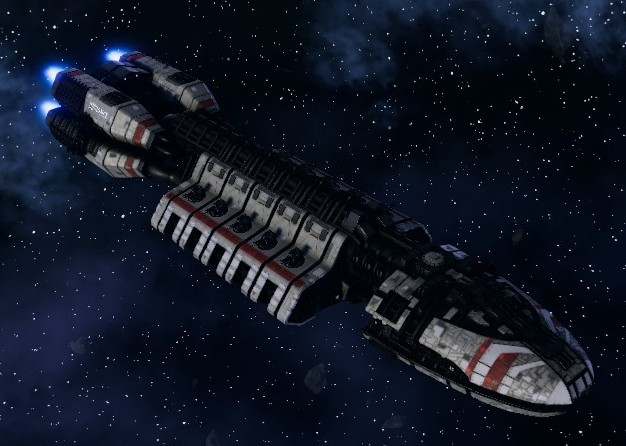
 Boskov01 — Hephaestus Class Forgestar

Published: 2020-05-02 19:30:51 +0000 UTC; Views: 9927; Favourites: 146; Downloads: 0
Redirect to original
Description
The image above was acquired via the Battlestar Galactica: War of the Colonies mod for Star Wars: Empire at War - Forces of CorruptionDisclaimer: The information below is not to be considered canon in Battlestar Galactica Lore and represents part of a "what-if" head canon scenario in my mind for an alternate universe, similar to the one created as the backstory for the "Battlestar Galactica: War of the Colonies" mod.
The 2CW Universe (Second Cylon War) is a what-if scenario where the initial surprise attack on the Colonies is mostly thwarted but not enough to prevent certain events from happening, like Laura Roslin becoming President via succession for example. The universe uses information from the series, Blood & Chrome, and Deadlock as well as several other fan works for inspiration.
Disclaimer: I am also aware that this design of ship was made by another user. I do not own this ship design. If you are the creator of this design, please message me below along with a link to the original and I will happily update with appropriate credit given.
Notice: This ship is originally the Sobek Class Battlestar from the Battlestar Hyperion universe: bsh.fandom.com/wiki/Sobek_Clas…
...
Class: Hephaestus Class Forgestar
Colloquially: Factory Ship, "Fraktory"
Designer: Quade Design Collective
Function: Front-to-mid Line Industrial Manufacturing Support/Combat Carrier
Armaments: 26x Light Battlestar Artillery Batteries, 6x Missile Tubes, 300x Dual Point Defense CIWS, Flak Batteries
Compliments: 50~75 Vipers, 10~15 Raptors, 20~30 Support Craft
Crew (Aprox): 1000 Crewmembers, 500 Industrial Engineers, 100 Combat Pilots, 30 Support Pilots
"The Cylons have an edge in that they can be mass produced. Troops, arms, ships, fighters...you name it, they have assembly lines for them all. We can't replace people, but gods willing, the Hephaestus will at least help us even the scales to some degree." - Adm. Peter Corman
History:
In the aftermath of the armistice, the Colonial Fleet, in their tactical review of the First Cylon War, recognized the vulnerability of their supply lines. The Cylons were able to resupply their forces faster than the Colonials could ever hope to due in no small part to being able to utilize deep space mining and manufacturing facilities while the Colonials had to mine the raw materials and ship them back to the colonies for production. To eliminate the middleman, the Colonial Fleet commissioned the Hephaestus Class Forgestar, a combination of Battlestar and factory. Three were built initially but in war games scenarios, the ability to manufacture parts and supplies closer to the front lines increased the overall effectiveness of Colonial Fleet operations. As a result more Hephaestus Class ships were commissioned. When the Cylons attacked and kicked off the 2nd Cylon War, the Hephaestus Class became a vital component of Colonial Fleet Operations.
The concept of producing service-ready equipment and vehicles is not new to the Colonial Fleet. The Mercury Class Battlestar was the test-bed for this concept and are capable of producing Vipers provided they have the resources. However the Hephaestus takes this concept and exponentially increases it, with the Hephaestus Class being designed explicitly for this purpose, thus reducing the strain on supply lines and also making the supply lines less vulnerable to being cut off by Cylon forces.
Technical Information:
The Hephaestus Class is the workhorse of the Colonial Fleet and is considered a vital component of almost any Battlestar Group. The Hephaestus Class functions almost identically to the average Colonial Battlestar but is geared more towards back-line operations. The Forgestar is deemed to be a "Battlestar" by Colonial High Command and was selected by Admiral Alphonso Quade, the son of Sinon Quade, as his flagship for the 83rd Battlestar Group. Forgestars are slightly smaller than Jupiter Class Battlestars but despite its size, its armaments fall into a "Light Battlestar" classification. Its compliment of Vipers and Raptors is also low for a vessel of its size. The Hephaestus, by default, is not equipped with nuclear ordinance but can manufacture a near endless supply of ship-to-ship missiles to compensate. If necessary, they can manufacture nukes but Colonial Command has restricted the manufacture of nuclear ordinance to more dedicated military arms plants. A Hephaestus Commander would need to get permission from their Group Commander to produce nukes and the Group Commander would need to personally sign off on any requisitions for each individual nuke. The Hephaestus largely replaces, if not surpasses, the old Celestra Class Support Ships used during the first war, carrying a supply of resupply raptors to restock ships with munitions and ordinances even during battle. The use of armor enhancing drones used by the old Celestras was discontinued during the first war when the Cylons found a means of hacking the drones and disabling them. To compensate for the loss of these drones, the Hephaestus instead can aid in repairing damaged ships by providing replacement parts and hull plating although not while in combat.
The Forgestar, as its name implies, is designed to locate resource rich asteroid fields or moons, park within a reasonable distance, and then deploy squadrons of deep-space mining vessels to begin harvesting out the resources. The mining vessels then transport the resources to the Forgestar, docking in one of the sixteen resource bays along the Forgestar's lateral structures to drop off the resources before flying back to repeat the process. The Forgestar's large interior contains a built-in foundry to process the resources while a large factory floor rests on the levels below the foundry to transform the raw materials into whatever is needed by the Fleet. The Hephaestus can manufacture a wide range of arms and equipment given the right materials. From objects as small as nuts and bolts to anything as large as a Colonial Shuttlecraft. In theory, the Forgestar could even manufacture corvette sized vessels, using its inverted flight decks as large construction gantries but none have thus far been attempted as the hangar decks are needed for incoming and outgoing supply ships to transport supplies to and from Colonial Forces across the theaters of war. Forgestars can refine tylium ore into fuel, but foundry work has to be dedicated exclusively to the Tylium refinement due to the volatile nature of tylium ore. The Forgestar's ability to manufacture parts and equipment for the Colonial Fleet has also enabled it to produce the parts and hull plating necessary to repair larger ships. As such the Forgestars can deploy small repair craft to aid in any major repairs to damaged Colonial craft. The repairs are typically enough to undo any damage the Cylons might inflict but as many a commander will comment "it's better than nothing" and the repairs often are necessary to help the damaged craft manage long enough to limp back to the Colonial shipyards for more in-depth repairs. However the reduced need for a return to the shipyards has helped the Colonial war machine immensely, allowing the shipyards to focus more on building new ships rather than spending time repairing and resupplying damaged ones.
The factory and refinery sections of the Hephaestus are often hot and most of the work is done through manually controlled robotics. Many of the engineers and assembly line workers refer to the production floors as the "Fraktory", a term that's grown to refer to the whole ship by other fleet crews. Because the Cylons have incredible hacking capabilities, the factory computers operate on a closed network, separate from the Forgestar's own systems. Most of the machinery is manually controlled anyway. There is a computer in the Forgestar's CIC that is linked to the factory systems but not the ship's systems that allows for orders to be relayed direct from the CIC to the factory. If Cylons were to attempt to hack the Forgestar's factory systems, they would have to physically board the vessel and uplink manually through a hardcable connection to begin the hack. Despite its armaments and modest compliment of Vipers for a ship its size, the Hephaestus Class is typically still escorted by a small wing of escort ships and are considered mid-to-rear echelon forces. They're often accompanied by larger Colonial Mining Vessels and Foundry ships that've been pressed into service for the Colonial Military, making the collection and processing of resources quicker while also freeing up industrial crew for the production floor.
Compared to the Mercury Class's fighter production facility, a single Hephaestus can manufacture a squadron's worth of Vipers within a week while it takes a Mercury about a month to build a single viper. In an Anabasis Scenario where a fleet is isolated from the Colonies or from Fleet Command for extended lengths of time, the presence of a Hephaestus effectively makes the fleet self-sufficient. Combined with an Agriculture configured Athena Class Battlestar, and a fleet could function in deep space almost indefinitely. As such, most Battlestar Groups include a Hephaestus dedicated to supplying them.
In combat, a Forgestar is rather durable, capable of sustaining incredible amounts of punishment but its own firepower is outmatched by even some of the smaller Battlestars in service. Even the long retired Artemis Light-Battlestar is considered to have heavier firepower than the Hephaestus Class. It does however suffer from a relatively poor thrust-to-mass ratio, making for a slow moving target compared to even the larger Jupiter Class or Mercury Class Battlestars. However given the weapons' distribution of her armaments, this is seldom an issue when in combat maneuvers.
The Hephaestus Class is unique in that it slightly departs from the typical Battlestar design trend. Its forward "alligator" head seamlessly connects to its main hull and engine sections, making it appear to be one large section with the two external flight pods. Earlier designs of the Hephaestus lacked the flight pods but after some consideration, the flight pods were added to increase the overall effectiveness of the Hephaestus as a factory ship, making loading and unloading faster and more efficient.
Related content






Comments: 21

👍: 1 ⏩: 0

👍: 1 ⏩: 0

👍: 0 ⏩: 1

👍: 0 ⏩: 0

👍: 2 ⏩: 1

👍: 1 ⏩: 1
👍: 0 ⏩: 1
👍: 0 ⏩: 1
👍: 0 ⏩: 1
👍: 0 ⏩: 1
👍: 0 ⏩: 1
👍: 0 ⏩: 1
👍: 0 ⏩: 0
👍: 1 ⏩: 1
👍: 1 ⏩: 1
👍: 0 ⏩: 1
👍: 0 ⏩: 0

👍: 1 ⏩: 1