HOME | DD
 Gorger — Legacy - The Matula v2

Published: 2013-11-10 13:10:04 +0000 UTC; Views: 1682; Favourites: 6; Downloads: 2
Redirect to original
Description
Matula
(Serperesapiens impavidus)
A non-humanoid race and the third sentient species found in the gas giant Shuroa, the Matula stand out not just for their enormous size, but also their reverence for the glory of the hunt
Biology
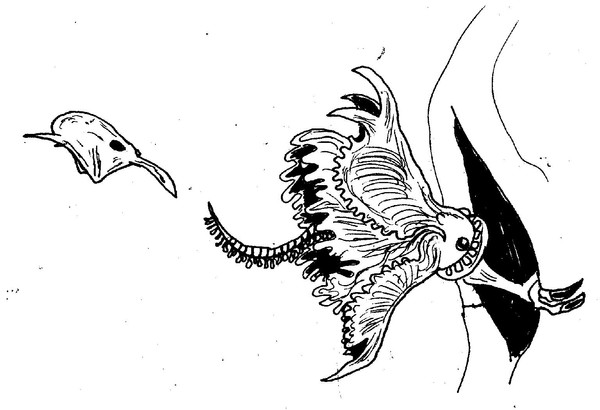
The Matula are invertebrates of greatly elongated, vermiform shape, reminiscent of Earth’s annelids or certain kinds of gastropod. Considered among the largest known sophonts, adults range up 18 feet in length and between 60-70 kg in weight, although even longer individuals are known to exist from time to time. Their bodies grow narrower towards what could be considered the “tail”, eventually branching into two pairs of “arms” that end in two claw-like digits each.
At first glance a Matula appears to be covered in a dense coat of fur, but closer inspection reveals it to be in fact a layer of highly modified skin, each “hair” a fleshy cilium roughly the shape and size of a human finger. Densely packed with sensorial receptors, these appendages provide the Matula with an exceptional awareness of their surroundings, and are so sensitive to stimuli they effectively allow them to smell, hear and even dimly “taste” without possessing the corresponding organs like more ordinary races. They are an indispensable element in Matula communication, and, being partially mobile, can be arranged in certain patterns to trap air and aid with insulation. Coloration varies from a dark blue to almost black.
The head is round and proportionally small, with tough leathery skin usually in various shades of cream. Eyes are located at the end of flexible, retractable stalks, and can range in number from just two to as many as six. Within the wide mouth are housed four opposing “tooth plates” that twist side to side towards a central point like organic saws. A component within the saliva, dubbed by scientists as Tuladine, is considered one of the most powerful anesthetics known to modern science; even the smallest dose slows cognition and completely numbs all physical sensations for hours at a time.
With most of their body mass comprised of -and supported by- muscle, Matula are shockingly agile for their bulk and navigate with ease through most environments, even squeezing and squirming through the smallest openings. Their internal organs are for the most part elongated and run across the bodily length, in particular the digestive system and their network of bag-like hearts. Lacking respiratory organs like other species, they absorb oxygen directly through their skin; the frequent rippling of their cilia serving to diffuse it through the blood. Uniquely among the galactic races, the Matula are hermaphrodites, every individual possessing both masculine and feminine organs. The dagger-like penis and vaginal opening are located within a reversible “pouch” sitting halfway through the Matula’s body. Sandwiched between the four posterior arms is the anus, and close to it is a nozzle-like gland that secretes a thin but strong silk.
Matula reproduction is tied to the seasons, becoming fertile for a period of three T-months every Shuroan year (15 T-months). Eggs, gelatinous and about the size of a human head, are fertilized internally and laid in clumps of 5-6, nestled in a small cocoon of silk woven by the brooding parent. The hatchlings emerge after 8 T-months of incubation and rely heavily on their parents for the early years, but quickly become autonomous. Sexual maturity happens at 16 T-years, and the estimated lifespan is of 200-250 years, although very few die of old age.
Psychology
Matula are a proud, stoic people with a highly individualistic streak. To the inexperienced they might appear dull or humorless, given they have little if any facial expressions, but the Matula can be quite emotional in more subtle ways than other races perceive. All things said, by their upbringing most Matula have a strict sense of duty and aren’t comfortable spending more time than necessary in leisure; they see the world as a perpetual hunt-or-be-hunted scenario, always alert for the next move.
The Matula have a great sense of personal honor which they follow with near-religious dedication. All debts must be repaid, and all challenges are to be accepted, for a Matula with no respect from others is already forgotten. It is in these situations where they display their infamous patience and determination; A proper Matula will exhaustively observe and plan the best course of action before finally acting, and once it acts it will never give up on allies, battle, or quarry, even if it means spending years tracking a dangerous foe or struggling through a problematic task. For younger Matula, inexperienced and eager to prove their worth, tending to their honor might sadly translate to bragging, bullying, spur-of-the-moment decisions and refusing to listen to reason.
Despite this, the Matula can be surprisingly optimistic, seeing defeat as a temporary setback that they can bounce back from and overcome. As hermaphrodites, they consider themselves of one gender, and are confused by the multiple sexes of other races, to the point of assuming they’re different species altogether.
Diet
Matula are purely carnivorous, unable to digest anything but the meat of other creatures. Nothing is wasted on their known meals, from the meat and blood to the bone marrow and viscera - the eyeballs of several species are especially popular as snacks. Coupled with the fact they prefer their food raw (as it is fresher and more savory that way), sharing table with a Matula makes a revolting experience for many other races. Their most common beverage, a sort of “ fermented meat-wine” known as Mhald, is infamously hard to stomach by even the most hardened Vornai.
Table salt is lethally toxic to the Matula organism, and they find its regular consumption by other species to be utterly baffling.
Culture
To the Matula, life is all about the pursuit of glory and personal success. The higher their prestige, the higher status they hold within their tribe; more food, better weapons, the most desirable mates. And as expected from descendants of predators, few challenges are more sought after than battle, and the hunt.
Most Matula live for the hunt. For them, it is more than sustenance, or elimination of threats, but the grandest entertainment, the art to prove their worth. To track the most dangerous creatures, slay them in ferocious combat, and bring them home as trophies is a supremely glorious act, an irreplaceable thrill that satisfies their innermost desires. All sorts of mementos can be taken from the hunt, but bones, which already fascinate Matula due to their own lack of skeletons, are the most desirable trophies. A Matula will proudly display the fruits of hir success all over hir dwelling, or wear them on their bodies if size allows for it.
It must be noted, however, that while the hunt is a most sought after source of prestige, the Matula accept other ways to show one’s worth. One whose skill in the battle is far from perfect can sharpen hir mind and devise cunning strategies for the hunt, or excel at trading with others for more resources, or craft tools and vehicles for hir kin to use, or provide the tribe with constant, reliable meat. Or could simply be someone that supports its allies and family to the end. As the Matula put it, not every Matula can be the strongest hunter, but each must inspire others to fight at their side, and die at their side if necessary.
For all the ferocity they embrace on the hunt, the Matula sense of honor ensures they follow a strict code; whether animal or sapient, only worthy game is to be engaged, and the young, elderly, infirm or innocent must not be harmed. One must not interfere on another’s hunt without permission, or steal their kill, and those that defeat you in a fair battle must be respected, and seen as equals. Betraying any of these laws is a dishonorable crime worthy of exile or even death, and wrongly accusing another of breaking them is seen just as negatively.
Some Matula might proudly trace their ancestry back to mighty hunters of old, but to a Matula having renowned parentage does not immediately grant respect; it must be earned. Thus, they judge everyone not by association or lineage, but by their deeds. This means they have no trouble dealing with individuals other races might act hostile towards, or with openly disliked races like the Klurrrg.
The Matula, like the other Shuroan inhabitants, pass down their stories and traditions orally and every tribe possesses many highly-respected storytellers. Art is often described as crude, but straight-forward in its messages.
Society
Matula live in small clan-based tribes referred to as Fraalfas (“home-holes”), loosely independent from one another. There’s no government; given the individual nature of the species, most Matula refuse to bow before others, and the closest thing to leadership falls on the Meroffos (“Grand Blooded”), those with exceptional prowess in significant deeds and that inspire great respect into others. They will protect their kin and speak in behalf of them, but do not consider themselves rulers.
Family units are loose but quite large, as every Matula is bound to have several siblings. Pairs are deeply bonded, but because each individual seeks a mate of equal status courtship can potentially last years. The mating process is a lengthy and violent affair where both partners extend their penises and try to force down and impregnate the other. Thought to have started as a form of breeding control, in modern times it is more like a tradition or formality, as Matula in general don’t really care who gets to bear offspring. A recent trend is for both partners to impregnate each other, but that remains a rare sight..
Once the offspring hatch, both parents will raise them dutifully, teaching them the ways of the hunt until they can fend for themselves. This usually happens well before sexual maturity, but a Matula won’t be considered an adult until hir has managed hir first distinguishable kill; that very moment, and that first trophy they get, will mark their transition from Felk (“Tender”) to Ffos (“Blooded”). From this point on families tend to go their separate ways in search of glory, but the bonds always remain, and offspring periodically keep in touch with their parents, whether by distance or returning home after long periods of success.
A Matula in advanced age and enough honors may eventually retire, but few ever do; going for extended periods of time without performing any significant deeds might lose them respect on the eyes of their peers, and can just as easily bring emotional distress without what has been giving them meaning their entire lives.
With the rest of the galaxy having discovered Shuroa, the Matula have been the first to spread out into the new world, and can be found as anything from soldiers to guards to bounty hunters, mercenaries, and big game hunters, eagerly exploring the new frontier for the treasure of glory and eternal life.
Religion and spirituality
The Matula’s thirst for challenges is deeply rooted to their beliefs. All things must eventually come to an end, be them riches, material goods, the stars in the sky, and even life itself. The legacy one leaves upon the world, however, remains eternal. The Matula believe that those strong and bold and skilled enough will achieve immortality, forever enduring in memory. And so every last Matula seeks to prove hirself, to build their legend through feats of individual valor, great victories and glorious hunts, so that one day their tale will be told by their tribe’s storytellers, and remembered with song and praise. Failure to achieve so, to be weak and unnoticed, is to cease to exist; True death is when the world forgets about you.
The Matula do not have gods per se, but instead their myths focus on ancestral precursors, the Jungamffos (“Old Blooded”) that hunted across the lands in the infancy of the world and paved the way for their descendants to come. In tune with the individuality of the Matula, the Jungamffos are not worshipped, but emulated. Each of them seems to embody different lessons of life and hunt, and individual Matula might be drawn to revere a particular precursor if hir thinks it suits hir best.
Language
Lacking vocal chords, the Matula tongue is not spoken, but rather it is expressed through the use of chemicals. A veritable web of glands all over a Matula’s skin produce a wide variety of scents the owner can release into the air to communicate with others, combining and suppressing them in a myriad combinations for every possible situation and meaning. Needless to say, for other races it is utterly impossible to speak, and it only adds to the stereotype of the Matula not only as savage hunters, but also as smelling repugnantly.
Most Matula are forced to wear translator devices with them at all times in order to get around such handicap, but they can also make use of sign language, and can rustle their dermal cilia in audible patterns to show their emotions.
History
----------- See Dejarites ---------
-------The last sapient race from Shuroa, in this case an obligatory Predator homage

Related content



Comments: 5

A very interesting species that is incredibly fleshed out! The detail is incredible and it paints a clear picture for the entire species. Love their design and love the description!
👍: 0 ⏩: 1

I'm going to have to come back later and read every one of these deviations. They are so detailed. You will probably enjoy my stuff as well - we seem to be in the same "business."
👍: 0 ⏩: 0

They certainly have a very sophisticated sensory system, what with that body covering of sensory cilia. Kinda puts our nose, ears and tongue to shame. ^^
I also really like how their eating habits and foul smell are off putting to most races, and how they do not communicate with sounds but with smells. This makes it a challenge for us to interact with them in a meaningful way. Which makes sense, as I imagine that if we humans ever actually do meet any alien races in the future, interaction will have to overcome various barriers due to significant differences in physiology and behaviour.
On their hermaphrodism being unique among the sapient races of the galaxy, I'd say its rather more a case of them being the only hermaphrodites so far featured in the setting. The galaxy is a big place, and quite probably contains various hermaphroditic sophonts, though most of the races of the galaxy would of course still be unknown to the featured races in the setting's "present".
👍: 0 ⏩: 1

Pretty much, but as it stands it works all the same

👍: 0 ⏩: 0