HOME | DD
 Mapboi — Request: Pan-Semitic Union

#amharic #arab #east #ethiopia #federation #israeli #jewish #linguistic #maltese #map #middle #pan #semitic #union
Published: 2022-11-24 00:05:19 +0000 UTC; Views: 4525; Favourites: 24; Downloads: 5
Redirect to original
Description
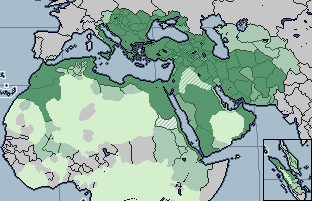
What exactly does "Semitic" mean? In the West, the term is commonly associated with Judaism and Jewishness, but in fact the Semites comprise a much broader ethno-linguistic family. The term "Semitic" comes from the biblical Shem, a son of Noah, though the linguistic family of that name also included the Canaanites (who were descended from Ham). Historically, the Semitic-speaking peoples included the early Levantine peoples - Jewish, Canaanite, and Aramean - as well as the Arabian tribes (who, according to some Abrahamic traditions, are descended from Ishmael, half-brother of the Israelite patriarch Isaac). However, the influence of these languages would spread well beyond these regions; Aramaic would, at one point, become the predominant tongue throughout the Fertile Crescent, Canaanite would spread via Phoenician colonization, and the Arabs would eventually expand to encompass the entirety of the Fertile Crescent and North Africa. Additionally, Semitic languages are predominant in Ethiopia and Eritea to this day, though the origin of these Afro-Semitic languages is still debated to this day. Even the Maltese tongue is part of the Semitic language family, though there is debate over its origin as well.
A Pan-Semitic Union would almost certainly have to be a federation. Pan-Semitic identity is not very strong; Pan-Arabism is also quite weak, and if it failed to unite the Middle East it is unlikely that this largely forgotten identity would succeed where it failed. Even among the Arab states, there are numerous other forms of identity (nation-states like Egypt, dynastic states like Saudi Arabia, etc.) that would be mutually exclusive with the concept of a centralized pan-Arab state. However, a loose federal structure that preserved these older identities would be more feasible, allowing countries to preserve their existing laws, governments, and dynasties. Incorporating the Jewish state of Israel, Christian Malta, and partly Christian Ethiopia and Eritrea would be difficult and unlikely to succeed in what would be primarily an Arab and Muslim union, but it could function if they were given considerable autonomy over internal affairs.
At the end of the day, a pan-Semitic union is something we would probably never see in practice, and would be unlikely to work very well, but as a concept it does have its merits. Perhaps the hostility of the Arab/Muslim world towards Israel would diminish if the Jewish state were incorporated into a largely Muslim federation; the main objection Muslims have towards the country is the fact that it is located on "Muslim land," which means there is a perceived religious obligation to "reconquer" it, but that would become less important here. Also, such a state would be something of a superpower in the making, if it could hold together. Depending on how centralized it is, the new federation might also serve to preserve stability and limit religious and political extremism as well. Overall, I don't think it's a realistic or practical scenario, but it is interesting to contemplate.